You desire substantially less government control of personal
activity and somewhat less government control over economic activity
than is presently the case in the U.S.
I used to classify this area as part of “Moderate Libertarian;” but got
many objections; I guess calling you a moderate libertarian is akin to
calling a liberal Democrat a &ldqup;moderate communist.;”
Your views would be best represented by a mix of Libertarian and Democratic
representatives—assuming that it was possible to get a significant
number of Libertarians elected. The Libertarian Party is still dominated
by people far more radical than you though there is an ongoing effort to make the LP more inclusive and
less radical. If you have the patience and willingness do deal with
infighting, you may want to join this effort. Or, you might find my
proposed new party more to your liking.
The Libertarian Party was created to radically cut government—more than you
want.
Nonetheless, you might want to check them out to see if you want to add some Libertarians
to the mix of D's and R's currently in power, since the D's and R's are making
government bigger than you want.
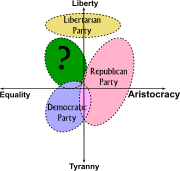
So, you want more freedom but you think the Libertarian Party is too radical?
The
Libertarian Reform Caucus consists of freedom lovers who want to turn
the LP into a real political party, one that balances idealism and
political reality.
Not happy with the existing parties? Would you like to see a political party
that was concerned about freedom and equality? Would you like to
shrink big government and big corporations?
I am contemplating starting such a party. It could be either a new party or
reforms to one of the existing third parties.
In my
Business Plan for a New Party
I seriously address the challenges inherent in third party politics in the
United States. Third parties generally fail, because the system is rigged against
third parties. However, there are a couple of interesting loopholes...

The Democratic Freedom Caucus.
Yes, there is a caucus within the Democratic Party that calls for
smaller government, but like other Democrats, they are greatly concerned with
equality.
Liberty and Other Values
Freedom, equality, morality, nature,...these are all good things. All to often,
political debate rages over which is more important. Synergies get
overlooked. There is a better way,
holistic politics.
By looking at multiple values at the same time, it is possible to come up
with creative solutions for the world's problems,
solutions that make
all the factions more happy.

Think economics is just about predicting interest rates? Think again!
Marginal Revolution is a very
interesting economics blog written by professors at George Mason University.
Political Strategy
The Leadership Institute.
Provides quality training in "political technology" for
conservatives and libertarians.
Essays on World Liberation.
Once upon a time, I was a hardcore activist in the Libertarian Party, going
so far to sit on the National Committee and be on the Strategic Planning Team (SPT).
These essays are an outgrowth of said experiences and my experiments in the field.
Since then, I have been
informed by “real” Libertarians
that the LP should be a protest organization, and that I have been
corrupted
by my attempts at Libertarian victory. However, if you think the purpose
of the LP is to actually elect libertarians,
these old essays may prove useful.
Take Back Your Government, by Robert A. Heinlein. A handbook
for grassroots political activism from the days before professional
consultants and television. Dated, but still useful.
Dedication and Leadership by Douglass Hyde. An inside look
at how the Communist movement was so successful in advancing its radical
agenda. Many of the ideas are apropos for building up the
political movements in general. Must reading for anyone doing third party politics.
Read to Lead
Law's Order, by David Friedman.
OK, so you believe in property rights, right? So where does your property begin
and mine end? Do I have the right to turn on the lights or do the photons that
hit your property constitute tresspass? What if those photons come from a high
powered laser?
OK, that was an extreme example, but there are many real world examples where the
simplistic view of property rights fails. Dr. Friedman gives them a hard look.
People will take your ideas more seriously if you do too.
The Machinery of Freedom, by David Friedman.
This book looks at the economics of government itself. What are the
incentives of those who govern? To what degree are they motivated to
promote the general welfare?
The answer: not very much. For this reason Dr. Friedman is an anarchist.
But you don't have to be in order to benefit from this book.
Indeed, knowing the inherent difficulties in making government behave is more
important for those who like government big than for those who like it small.
Simple Rules for a Complex World, by Richard Epstein.
It would be nice to simply say that private property is good and
that initiation of force is bad and
build a legal system based on this dictum. Alas, the real world is not so
simple. Legal scholar Richard Epstein points out the holes and suggests
additional axioms to make a complete legal system for a free society.
Fuzzy Thinking, by Bart Kosko.
Fuzzy Logic is one of the biggest advancements in philosophy to come around in a long
time. It deals with the imperfect mapping between words and reality. Must reading for
the philosophically inclined, especially followers of Ayn Rand or Murray Rothbard.
A Perfect Mess by Eric Abrahamson and David H. Freedman.
Does your office have a clean desk policy? Does it try to document all
processes in the name of efficiency? Are planners trying to remake your
home city? Do you think that the laws should be based upon a clean
axiomatic framework?
This book provides a powerful antidote to such thinking. Reality is
multi-dimensional, and the results can be...messy.
Fun Reading for Freedom Lovers
The Futurological Congress, by Stanislaw Lem.
Imagine a utopia—or is it dystopia—based on hallucinogenic drugs.
Inspired by life in communist Poland. Quite a hoot!
Alastor, by Jack Vance.
A collection of three light science fiction novels connected by the same broad background.
The third, "Wyst," is by far the best, and the one that is relevant. "Wyst" is a comedy
that takes place in something much closer to the Marxist ideal than was ever achieved
during the 20th century. Takes a fair look, both sympathetic and skeptical, towards a
true "Egalistic" society. The amusing characters and dialog alone make this well worth
reading.
Parliament of Whores by P.J. O'Rourke. A hilarious but
informative look at the workings of U.S. government.
(Avoid if you find the occasional four-letter word to be objectionable.)
Eat the Rich by P.J. O'Rourke. A very funny survey of various
economic ideas, from around the world. On-the-spot coverage of the
consequences of various economic ideas, where they were applied.
In this one, O'Rourke plays fair, with chapters such as "Good Capitalism," "Bad Capitalism,"
"Good Socialism," and "Bad Socialism."
The Moon is a Harsh Mistress, by Robert A. Heinlein. Good
fiction for freedom lovers. This one turned me into an anarchist for about a
decade.
That Hideous Strength by C. S. Lewis. Part III of Lewis'
space trilogy. The plot has some fascinating parallels to Ayn Rand's
Atlas Shrugged despite the fact that Lewis was a devout Christian while
Rand was a devout atheist.